



Disco Elysium: Final Cut delivers some of gaming's best writing with an amnesiac detective whose internal voices debate and sabotage. It runs on integrated graphics with an SSD and 30-60 FPS cap, though Final Cut's voiceover can strain older i3 CPUs during transitions. The payoff is branching builds, political depth, and razor-sharp dialogue that shine at low settings. Occasional hitches are worth tolerating for this literary high-water mark.

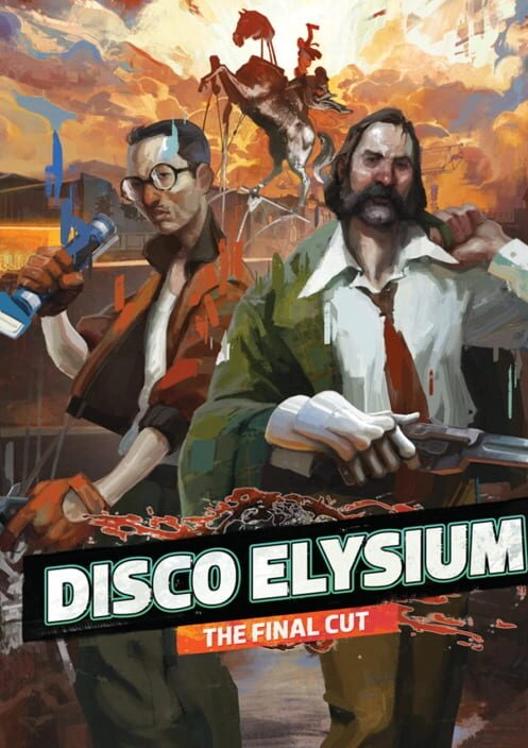
Disco Elysium: Final Cut
Best if you want a no-combat RPG where dialogue *is* the game—build a detective whose internal voices argue philosophy, sabotage conversations, and define your playstyle through razor-sharp writing and branching skill checks.
On This Page
Why We Recommend This Game
Disco Elysium reimagines RPG progression as a conversation with yourself. Your 24 skills—Logic, Empathy, Electrochemistry, Inland Empire—are voiced characters offering competing advice, hidden insights, and self-destructive impulses. Each point you invest doesn't just boost success rates; it changes how scenes play out, unlocking new dialogue branches, environmental observations, and ways to fail forward. The loop is deceptively simple: explore an isometric district, click to investigate, pass or fail skill checks through dice rolls modified by your build. But depth emerges from consequences. Failing a check can open surprising paths; internalizing "thoughts" over real-time hours reshapes your stats and worldview; choosing which voices to amplify—the fascist Ancient Reptilian Brain or the communist Mazovian Socio-Economics—fundamentally alters how you solve (or don't solve) the central case. Sessions naturally break into 20–30 minute chunks as you exhaust dialogue trees in one location before moving on. There's no filler combat to pad runtime; every interaction is handcrafted text. The learning curve is front-loaded: the first hour throws dense political theory, invented terminology, and RNG failures at you. Stick with it. Once you grasp that failure is content—not punishment—and that your build is a roleplay tool rather than an optimization puzzle, the game clicks. Replayability comes from radically different builds and ideological stances rather than branching plot outcomes. A high-Intellect, low-Physical run feels mechanically and thematically distinct from a supercop who solves problems with Authority and fists. Expect 20–25 hours for one playthrough, with enough variation in tone, available checks, and approachable solutions to justify a second. Pacing is methodical, literary, and dialogue-dense. If you need kinetic feedback or moment-to-moment challenge, this will feel inert. But for players who want an RPG where *how* you think—not how fast you click—defines success, Disco Elysium delivers unmatched depth. The Final Cut's full voice acting (over a million words) transforms reading fatigue into an audiobook-quality experience, though it does tax older CPUs during transitions.
Best For
- Fans of literary fiction and dense, philosophical dialogue
- Players who enjoy RPG builds that reshape tone and available options rather than combat efficiency
- Anyone seeking a detective game where failure and mistakes create the best stories
Not For
- Players wanting action, reflex-based gameplay, or traditional combat
- Those averse to heavy reading or political/philosophical themes
- Completionists needing clear win-states—many checks are mutually exclusive by design
Multiplayer & Game Modes
Features
Play Modes
Single Player
Additional Details
No multiplayer features. Steam listing shows Single-player only (no online/local co-op, PvP, or LAN). PCGamingWiki also lists the game as single-player only.
Edition and Platform Information
Important details about which version to buy and where to play.
Which Edition to Buy
The Final Cut adds full voice acting for every line (1.2 million words), new political vision quests, and additional characters. Free for original owners. The voiceover significantly increases CPU load on older systems; expect occasional stutter on dual-core processors during area transitions, though gameplay remains smooth on integrated graphics with an SSD.
Platform Recommendations
Runs well on low-end PCs with integrated graphics (Intel UHD/Iris Xe) thanks to painterly 2D art and minimal GPU demands. An SSD helps reduce load times. Controller and keyboard/mouse both supported. Final Cut voiceover raises minimum CPU requirements compared to the original release.
Accessibility Features
Full voice acting in Final Cut; adjustable text size and UI scaling; colorblind-friendly UI; save-anywhere with frequent autosaves; rebindable controls; no time pressure or twitch mechanics. Reading-heavy by design—voiceover helps but still text-focused.
Screenshots
Click any screenshot to view in full size
Featured In Our Articles
We've included this game in 2 articles.
Disco Elysium excels on low-end hardware thanks to its painterly isometric art and Unity foundation that runs smoothly on Intel UHD/Iris Xe. Its RPG depth comes from dialogue checks, thought cabinet progression, and internal debates rather than GPU-taxing effects. Full voice acting elevates immersion without performance cost, and different builds genuinely reframe scenes. Perfect for story-focused players who want rich role-play without upgrading their PC.
Frequently Asked Questions
Common questions about this game answered by our team.
Is there any combat?
No traditional combat. All conflict is resolved through dialogue, skill checks, and choices. A few "action" moments use the same dice-roll system—think tabletop RPG rather than real-time fighting.
How long does it take to finish?
20–25 hours for one playthrough. Completionists might stretch to 30+ hours. Different builds unlock exclusive content, making a second run feel substantially different in tone and available options.
Do I need to like politics to enjoy this?
The game is saturated with political philosophy, but you can engage earnestly, satirically, or ignore ideology entirely. The writing is sharp enough that even players uninterested in theory enjoy the character work and mystery.
Can I mess up and lose?
You can hit dead-ends, but frequent autosaves and manual saves let you retry checks or explore alternate approaches. Failure often unlocks new paths rather than blocking progress—embracing mistakes is part of the design.
Is it good for RPG beginners?
Yes, if you're comfortable with reading. No complex combat systems or inventory management. The skill system is forgiving, and the game teaches through experimentation. Intimidating vocabulary eases after the first few hours.