




PlateUp! earns its #2 spot by delivering what Overcooked veterans crave: deeper systems. The roguelite structure lets teams build automation strategies across runs, while appliance daisy-chaining and floor planning reward smart role division. Online and local play suit Switch perfectly, though the steep learning curve and dense interface keep it from the top slot.

PlateUp!
Best if you want a deep, progression-driven kitchen sim that rewards strategic planning as much as frantic coordination—Overcooked meets roguelite restaurant building.
On This Page
Why We Recommend This Game
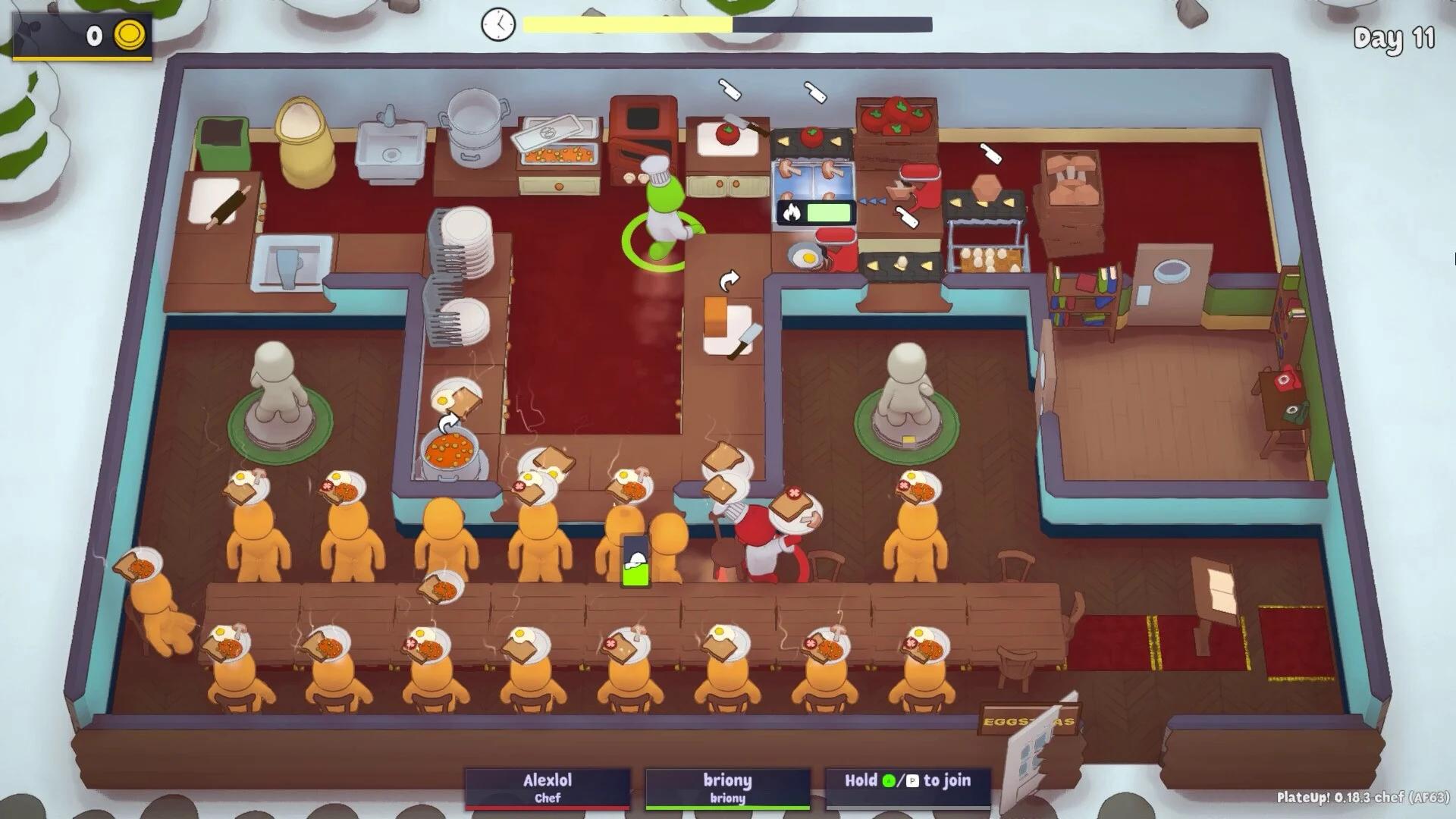
PlateUp! transforms the chaotic kitchen genre into something with lasting bite. Instead of resetting after every shift, you build a persistent restaurant over a 15-day run, expanding your floor plan, chaining together automated appliances, and unlocking new equipment between service rushes. The result is a game that asks you to think like a manager during downtime and execute like a line cook when doors open. The core loop splits neatly: during prep phases, you and up to three friends negotiate layouts, buy appliances, and plan automation—conveyor belts feeding ovens, dishwashers linked to serving stations. Then customers arrive and you scramble to fulfill orders while your clever (or chaotic) kitchen design reveals its strengths and flaws. Success hinges on clear role assignment: one player might handle all plating, another manages seating and patience meters, a third focuses on cooking stations. This division of labor makes it feel less like frantic button-mashing and more like a well-oiled crew finding rhythm together. The roguelite structure keeps stakes high. Fail to meet daily goals and your run ends, but you unlock new recipes, appliances, and modifiers for future attempts. Each restaurant is procedurally generated with unique layouts and customer quirks, so no two runs feel identical. The progression system rewards repeated play—you'll return to your franchise HQ between attempts to spend currency on permanent upgrades and cosmetics, then dive back in with fresh strategies. The learning curve is steeper than Overcooked. Early runs teach you the basics, but mastering automation, optimizing layouts, and juggling multiple dish types takes hours of experimentation. Solo play is viable but significantly harder; this game shines brightest with a dedicated co-op partner or group willing to communicate and iterate. Sessions typically run 30–60 minutes per full attempt, with individual day shifts wrapping in 5–8 minutes—perfect for "one more run" loops that stretch into entire evenings. It's not as immediately accessible or visually polished as its genre peers, and the UI can feel dense on handheld Switch screens until you internalize the icons. But if you've exhausted Overcooked and crave something with more strategic depth, persistent progression, and room to optimize, PlateUp! delivers a satisfying long-haul co-op experience that rewards teamwork and smart planning in equal measure.
Best For
- Overcooked veterans seeking deeper strategy and roguelite progression
- Co-op groups who enjoy planning, role assignment, and incremental optimization
- Players who love automation puzzles and permanent meta-progression
Not For
- Those wanting instant pick-up-and-play accessibility without a learning curve
- Solo players looking for a relaxed experience (difficulty scales steeply alone)
- Anyone frustrated by roguelite failure loops or procedural variance
Multiplayer & Game Modes
4 local • 4 online
PlateUp! does not support crossplay, supports up to 4 players online, features co-op campaign mode.
Features
Play Modes
Single Player • Multiplayer • Co-op • Online Multiplayer • Local Couch Co-op • Shared Screen
Player Count
- Local
- 1-4
- Online
- 1-4
- Team Sizes
- Co-op teams of up to 4
Additional Details
Supports 1–4 players co-op. Local play is shared-screen (no split-screen). Online co-op supported on PC via Steam (Steamworks/Remote Play Together supported). No official LAN mode listed. No official cross-play support indicated between platforms. Players typically form a single team running one restaurant; no PvP modes.
Edition and Platform Information
Important details about which version to buy and where to play.
Platform Recommendations
Switch version can feel cramped on handheld due to UI density; docked play with a full controller setup is recommended for multiplayer. PC version offers sharper visuals and slightly smoother interface navigation.
Accessibility Features
Clear color-coded stations and readable recipe icons aid coordination. Controller-friendly menus and sound cues support timing. No full button remapping on all platforms, but layouts are intuitive. Practice mode allows low-pressure experimentation before committing to runs.
Screenshots
Click any screenshot to view in full size
Featured In Our Articles
We've included this game in 2 articles.
Ranked #8 for adding meta-progression to the couch kitchen formula. Unlike reset-heavy alternatives, PlateUp! lets four players grow a restaurant together over multiple sessions through roguelite unlocks and automation systems. Teams assign domains—conveyors, dishes, floor layout—creating ownership beyond frantic execution. Steeper onboarding holds it back, but sustained replay rewards patient groups.
Frequently Asked Questions
Common questions about this game answered by our team.
How hard is PlateUp! compared to Overcooked?
Harder overall. Early days are approachable, but difficulty spikes as you progress through a run. Success depends on smart layout planning and role division, not just quick reflexes. Expect frequent failures while learning.
How long does a full run take?
A complete 15-day restaurant run typically lasts 30–60 minutes, with individual day shifts taking 5–8 minutes. Meta-progression encourages repeated attempts, so total playtime adds up quickly across unlocks.
Is it fun solo or does it require co-op?
Playable solo but significantly harder—you'll juggle all roles yourself. The game truly shines in 2–4 player co-op where you can divide tasks and coordinate automation strategies together.
Does progress carry between runs?
Yes. Failed runs still unlock new recipes, appliances, and franchise upgrades you can spend between attempts. Each run builds toward long-term progression, not just immediate victory.
Can I play online or only local co-op?
Both. PlateUp! supports online multiplayer and local couch co-op, making it flexible for remote friends or same-room groups. Crossplay availability varies by platform.