

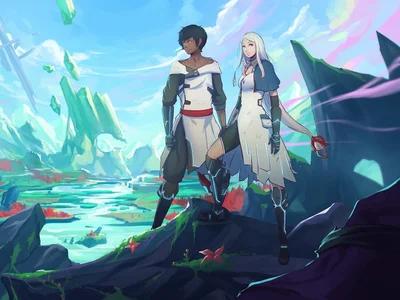
Moon Hunters takes a unique approach to co-op storytelling, generating procedural myths from your choices across short 1-2 hour runs. Perfect for local groups wanting narrative variety without long commitments, though combat synergy and character depth don't match the top story-driven picks. The mythology-building hook and quick sessions make it worth exploring for Switch co-op fans seeking something different.

The Verdict
Best if you want bite-sized co-op sessions that rewrite themselves each time, trading long-term progression for replayable myth-making where your choices literally become folklore.
What It's Like to Play
Moon Hunters thrives on brevity and reinvention. Each run lasts 1–2 hours, not because you'll die and restart, but because that's the complete arc: a five-day journey through procedurally shuffled encounters, conversation choices, and combat vignettes. When your adventure ends, the game crystallizes your decisions into a constellation myth—your character's deeds become legend, and you unlock new traits or classes for future runs. This loop feels less like grinding and more like telling different versions of the same bedtime story, seeing how the variables shift. The core gameplay blends light action-RPG combat with branching choice nodes. You'll pick a character class—each with distinct abilities, from the Druid's shapeshifting to the Ritualist's long-range spells—then roam a top-down map dotted with camps, shrines, and encounters. Combat is straightforward: dodge, attack, use your cooldown abilities. It won't demand execution mastery, but co-op groups need to coordinate since friendly fire is real and screen space gets crowded fast. The real texture comes from decisions: help a stranger or ignore them, mediate a dispute or pick a side. These moments feed into personality stats (Valor, Cleverness, etc.) that shape your final myth and unlock new story branches. The learning curve is gentle—15 minutes and you'll grasp movement, basic attacks, and choice consequences. Depth doesn't come from complex builds or loot hunts; it comes from exploring the permutations across playthroughs. Different character combinations open different dialogue, and procedural generation means you'll rarely see the same encounter sequence twice. That variety keeps early runs fresh, but after a dozen cycles, you may notice repetition creeping in. The constellation unlocks and trait modifiers add replay incentive, but they're modest bonuses rather than transformative progression. Session structure makes this ideal for couch co-op groups with limited time. You can finish a full run in one sitting, making it easier to schedule than sprawling 40-hour campaigns. Local four-player support shines here—everyone shares the screen, decisions are group votes, and the myth you build feels genuinely collaborative. Online multiplayer exists but is less active. Solo play is viable, though the myth-building conceit loses some magic without a group interpreting the legend together. Pacing is brisk, almost rushed at times. Days fly by, and you may wish for more breathing room to explore character builds or dig into the world. That's a trade-off: Moon Hunters values replayability over depth in any single run. If you crave incremental gear upgrades or long-term character investment, this will feel thin. But if you want a co-op experience that respects your time and celebrates improvisation, it delivers a distinctive, folklore-flavored loop.
Best For
- Local co-op groups seeking 1–2 hour sessions with full narrative closure
- Players who value replayability and emergent storytelling over linear depth
- Indie fans curious about procedural myth-making and choice-driven folklore
Not For
- Players expecting deep build customization or loot-driven progression
- Solo completionists—the myth-crafting hook loses resonance without co-op discussion
- Those wanting complex combat mechanics or high execution ceilings
About Moon Hunters
Story setup
At a glance
- Released
- March 10, 2016
- Platforms
- PC, macOS, Xbox One, Nintendo Switch, PlayStation 4, Linux
- Genres
- RPG, Adventure, Indie, Action, Casual
- Play modes
- Single Player, Multiplayer, Co-op, Online Multiplayer, Local Couch Co-op, Shared Screen
- Age rating
- ESRB E10+
- Multiplayer
- By platform
- Metacritic
- 62
- Player rating
- 3
Screenshots
Click any screenshot to view it full size.
Multiplayer by platform
How Moon Hunters supports playing with other people, broken down per platform.
| Platform | Local | Online | LAN | Split-screen | Co-op campaign | Drop-in/out |
|---|---|---|---|---|---|---|
| PC | Yes, up to 4 players | Yes, up to 4 players | No | No | Yes | No |
| Xbox One | Yes, up to 4 players | No | No | No | No | No |
- Supported (a number is the player cap)
- Not supported
- Not documented for this platform
CrossplayNo Crossplay
Team sizes · Co-op teams up to 4
Supports 1–4 player co-op. Steam lists both Online Co-op and Shared/Split Screen Co-op; gameplay is shared-screen (not split-screen). PCGamingWiki indicates no LAN support. No official cross-platform multiplayer support indicated across storefront/PCGamingWiki sources.
Age ratings
How rating boards around the world have classified Moon Hunters. Open a board for its content descriptors.
ESRBE10+
- Fantasy Violence
- Mild Blood
PEGI7
- Violence
Edition and platform notes
Which version to buy, and what differs between platforms.
Platform Recommendations
On Switch, handheld mode can make UI and on-screen text feel sparse or hard to read, especially with multiple players. Docked play offers better readability. Performance is stable across platforms.
Accessibility Features
Text-heavy choice nodes may be difficult to parse in handheld mode due to small font size. Friendly fire and screen crowding in four-player co-op can be challenging for players with limited visual tracking.
Featured in our articles
This game appears in 1 article on this site.
Frequently asked questions
Common questions about this game, answered by our team.
How long does one playthrough take?
Each complete run takes 1–2 hours, covering a five-day in-game journey from start to constellation myth. Perfect for a single evening session.
Is this good for beginners?
Yes. Combat and controls are simple, and the game explains choice mechanics early. The challenge is exploration and experimentation, not execution skill.
How much replay value is there?
Procedural encounters, multiple classes, and branching choices offer strong variety for 10–15 runs. After that, you may start seeing repeated content and diminishing surprises.
Can I play this solo or is co-op required?
Solo play works mechanically, but the myth-making theme and group decision-making lose impact without co-op partners to share the legend with.
Does it have deep RPG progression?
No. Progression is light: unlocking new classes, traits, and constellation bonuses. Each run is self-contained with minimal stat growth, focusing on narrative variety over builds.
Game data and imagery provided by IGDB.com

