








Moving Out creates shared chaos that tests couple communication through furniture-hauling puzzles. Its assist options let you dial back stress for date nights, while physics-driven moments generate natural laughter when plans fall apart. Best for duos who can laugh off mistakes and enjoy Overcooked-style coordination without taking it too seriously.

Moving Out
Best if you want a physics-driven party game that delivers Overcooked-style teamwork chaos with furniture instead of food, complete with assist options to keep the laughs flowing when the coordination gets tough.
On This Page
Why We Recommend This Game
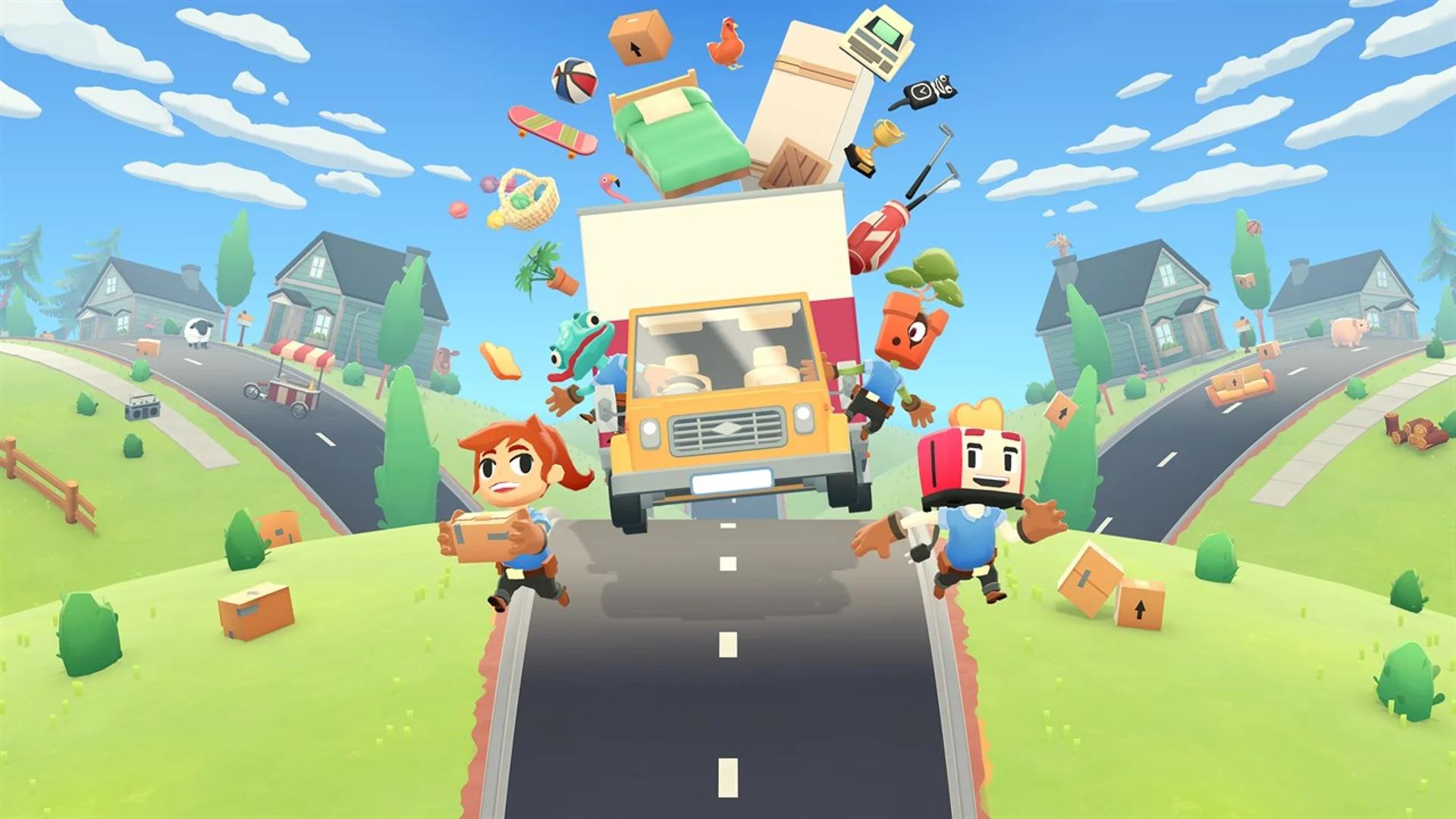
Moving Out turns the mundane task of hauling furniture into a slapstick physics playground where precision matters far less than creative problem-solving and shameless improvisation. Each job starts simple—load items into a truck before time runs out—but the game constantly escalates with haunted houses, zero-gravity zones, portals, and even moving planes. The joy comes from discovering that the 'proper' way to move a couch is often slower than just hurling it through a second-story window. The core loop thrives on short, digestible missions that last 10–20 minutes each. You'll assess a space, plan routes with your crew, then watch those plans crumble as someone accidentally tosses a lamp into a pool or gets wedged in a doorway. Unlike more punishing coordination games, Moving Out includes robust assist options: extended timers, reduced item counts, and simplified objectives let mixed-skill groups dial the difficulty to match their tolerance for chaos. That flexibility makes it accessible for families, casual duos, or party groups who want laughs without the stress. The physics engine is both the game's strength and occasional weakness. Ragdoll characters and wobbly furniture create genuinely funny moments—chairs bouncing off walls, players tumbling down stairs—but sometimes the unpredictability crosses into frustration, especially when chasing high ratings or gold medals. Perfectionists may find the loose controls work against them, while groups focused on just finishing jobs will embrace the absurdity. Solo play is functional but lacks the emergent comedy of multiplayer. The game dynamically adjusts item counts and objectives based on player count, so whether you're hauling with one friend or three, the challenge scales appropriately. Local couch co-op is the ideal format, though online multiplayer expands your options if your crew is remote. Replayability hinges on whether you're content with completion or crave mastery. The 50+ levels offer variety through environmental gimmicks and bonus objectives, but once you've seen the mechanics, replay value depends on chasing leaderboards or returning for party sessions. Versus modes add competitive spice, though the cooperative missions remain the main attraction. For groups seeking an Overcooked alternative with slightly gentler stakes and more room for slapstick improvisation, Moving Out delivers consistent, if occasionally unruly, fun.
Best For
- Groups seeking chaotic couch co-op with Overcooked-style teamwork but more forgiving physics
- Couples or families who enjoy coordination challenges but want assist options to reduce stress
- Party sessions where short missions and slapstick humor matter more than precision
Not For
- Players seeking tight, predictable controls—the physics can feel loose and occasionally frustrating
- Solo enthusiasts looking for deep single-player campaigns—it's built for multiplayer laughs
- Perfectionists chasing flawless runs—the unpredictable physics actively resist precision play
Multiplayer & Game Modes
4 local • 4 online
Moving Out does not support crossplay, supports up to 4 players online, features co-op campaign mode.
Features
Play Modes
Single Player • Multiplayer • Co-op • PvP • Online Multiplayer • Local Couch Co-op • Shared Screen
Player Count
- Local
- 1-4
- Online
- 1-4
- Team Sizes
- Co-op up to 4
Additional Details
Supports up to 4 players in co-op (local shared-screen and online). Steam lists Online Co-op and Shared/Split Screen Co-op (shared-screen). No LAN mode listed on PCGamingWiki. No official cross-platform multiplayer support indicated for Moving Out (cross-play not supported). Party/versus modes are competitive score-based. Online play on consoles typically requires the platform’s online subscription (e.g., PS Plus / Nintendo Switch Online / Xbox subscription), depending on platform policies.
Edition and Platform Information
Important details about which version to buy and where to play.
Platform Recommendations
On Switch, expect occasional frame drops and camera hiccups during busy 4-player sessions, which can interfere with precision throws and tight doorway navigation. Performance is more stable on other platforms.
Accessibility Features
Robust assist mode lets you extend timers, reduce item counts, and simplify objectives, making it accessible for mixed-skill groups and families. Cartoon visuals stay readable even during chaotic moments. Local and online co-op setup is straightforward.
Screenshots
Click any screenshot to view in full size
Featured In Our Articles
We've included this game in 3 articles.
Moving Out 2 offers Overcooked-style chaos with furniture instead of food, supporting up to 4 players through absurd houses and interdimensional stages. Short missions and assist modes keep it accessible, while physics-driven comedy rewards both planning and improvisation. Unpredictable physics can frustrate perfectionists, but for groups seeking low-stakes laughs, it delivers.
Moving Out 2 delivers cooperative slapstick with solid 4-player design and assist options that keep groups engaged. However, Switch performance issues—frame dips and camera hiccups during busy moments—undermine the precision needed for tight doorways and tosses. The concept is strong, but technical inconsistencies keep it below more polished couch staples.
Frequently Asked Questions
Common questions about this game answered by our team.
How hard is it?
Difficulty scales based on whether you enable assists. Default mode can be frantic with time pressure, but assist options let you extend timers and reduce challenge significantly, making it date-night or family-friendly.
How long does it take to finish?
The 50+ levels take roughly 6–8 hours to complete casually. Chasing gold medals and bonus objectives can double that, but most groups play in short party sessions rather than marathon runs.
Is it good for beginners?
Yes, especially with assists enabled. The physics are forgiving enough that mistakes become funny rather than punishing, and the game tutorializes mechanics gradually across early levels.
Can I play solo?
Yes, and the game adjusts objectives for single players, but the comedy and chaos shine brightest in multiplayer. Solo play is functional but loses the emergent teamwork moments that define the experience.
How does it compare to Overcooked?
Similar structure—short timed missions demanding coordination—but Moving Out's physics are looser and more slapstick. It's slightly less stressful with better assist options, trading Overcooked's precision for improvisational chaos.