
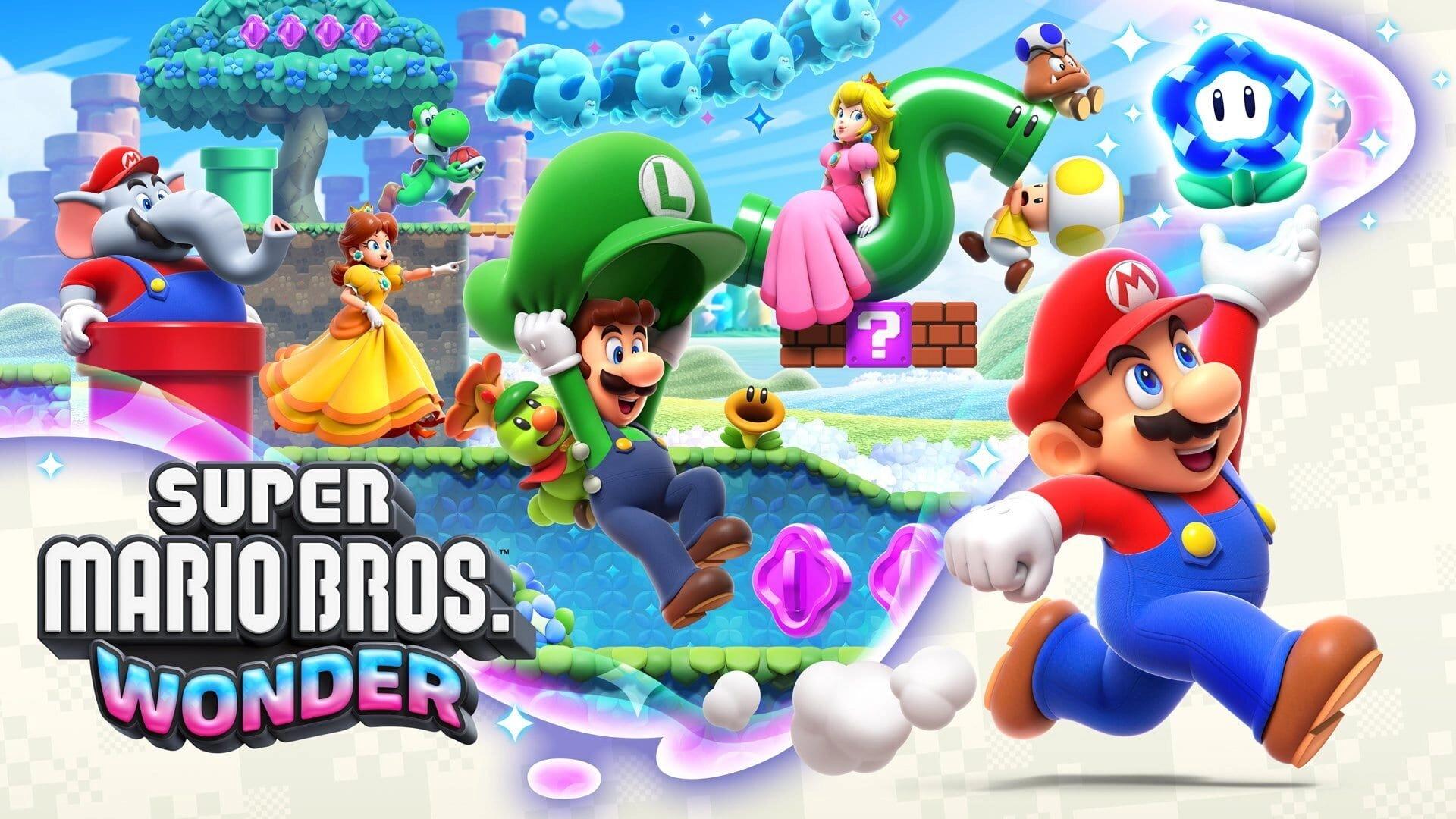
Super Mario Bros. Wonder finds new tricks that make four-player co-op genuinely fun again. The Wonder Flower moments turn every level into something unpredictable, pipes wriggling, enemies turning into balloons, and the badges let a weaker player self-handicap without anyone feeling singled out. My younger kid uses the Safety Bounce badge and still keeps up with the rest of us, which is exactly the kind of accommodation that makes family sessions work instead of turning into someone crying on the couch. It sits below the pure co-op specialists on this list because four-player platforming means bumping into each other at the worst moments. That friction is real. Even so, it is one of the most reliably fun thirty-minute windows on the whole console.

Super Mario Bros. Wonder
October 20, 2023PlatformerESRB E
About Super Mario Bros. Wonder
Story setup
At a glance
Screenshots
Click any screenshot to view it full size.
How long to beat
Player-reported completion times for Super Mario Bros. Wonder.
- Rushed
- 6hoursMain story only
- Typical
- 9hoursStory plus some extras
- Completionist
- 23hoursEvery side objective too
Estimated from 7 player reports — a small sample, so treat these as approximate.
Multiplayer & game modes
supports up to 12 players online.
4 local • 12 online
Features
Play Modes
Single Player • Multiplayer • Co-op • Local Couch Co-op
Player Count
- Local
- 1-4
- Online
- 1-12
Age ratings
How rating boards around the world have classified Super Mario Bros. Wonder. Open a board for its content descriptors.
ACBG
Very mild fantasy themes and violence, online interactivity
ESRBE
- Mild Fantasy Violence
Often listed alongside Super Mario Bros. Wonder
Titles that appear in the same guides on this site. Grouped by where they show up, not by recommendation.
- Kirby and the Forgotten Land
- It Takes Two
- Stardew Valley
- Teenage Mutant Ninja Turtles: Shredder's Revenge
- Minecraft
- Mario Kart 8 Deluxe
- Luigi's Mansion 3
- Super Mario 3D World + Bowser’s Fury
- Snipperclips Plus - Cut it out, together!
- Overcooked! All You Can Eat
- Super Smash Bros. Ultimate
- Diablo III: Eternal Collection
Featured in our articles
This game appears in 10 articles on this site.
Wonder is what happens when Nintendo decides to stop making safe 2D Mario games and actually tries something. Every level has a Wonder Flower that changes the rules entirely, and in co-op those moments land differently because you are experiencing them at the same time as someone else. My youngest watched me play the first few levels and immediately wanted a controller. Ten minutes later, that controller was operational. The onboarding here is about as low as a platformer gets. It does not have the depth of Smash or the replay longevity of Kart, but for a couch game with people of genuinely different ages and skill levels, it earns its place.
Wonder is the most joyful two-player platformer on Switch right now. Every level does something unexpected, and the Wonder Flower mechanic means both of you are constantly reacting to new surprises rather than grinding through familiar territory. The accessibility here is genuinely impressive. My wife watched me play the first level and asked to join, which is a reliable test I apply to every game on this list. Drop-in co-op means nobody has to sit through a setup screen. The only reason it sits below 3D World is that the skill gap issue is slightly more present in the later worlds, but most couples will never get there.
Super Mario Bros. Wonder is what happens when Nintendo decides that every single level in a 2D platformer should have a reason to exist. The Wonder Flower effects shift the rules of each stage in ways you cannot predict, which means even seasoned players spend half the game surprised. It runs beautifully, looks gorgeous on a television, and the difficulty curve is gentle enough to play alongside kids without anyone getting frustrated. My only reservation is that the endgame challenge levels are optional, so players looking for genuine difficulty may finish the main story wanting more. As a broad recommendation, though, this is close to flawless.
Wonder earns its place here because the solo campaign is consistently inventive from the first level to the last. The Wonder Flower mechanic means you genuinely cannot predict what the next stage is going to do, and Nintendo uses that surprise budget wisely rather than blowing it all in the first world. It supports multiplayer but you do not need it. Played alone it moves at exactly the pace you set, and the difficulty curve is one of the gentlest on this list without ever feeling condescending. Shorter than Odyssey. That is fine. Not every single-player game needs to be a hundred-hour commitment, and sometimes a tight, polished campaign that respects your time is exactly what you want.

The Switch is built for same-room play, and Super Mario Bros. Wonder is the cleanest example of that promise delivered. Four players on one screen, no setup friction, no skill barrier that shuts anyone out. I played this with my kids on a Saturday afternoon and my youngest, who struggles with most platformers, stayed engaged the entire time because dying does not stop the group and the bubble mechanic means nobody gets left behind. That design choice sounds small until you have actually watched a frustrated child put down a controller. Wonder earns the top spot not because it is the deepest co-op game here, but because it works for the widest range of people without compromising how good it feels to play.

Every Wonder Flower stage does something the last one did not. That is not an exaggeration. The game commits to reinventing its own rules every few minutes, which means a child who played for twenty minutes last week comes back to something that still surprises them. I tested this with someone who grew up on the New Super Mario Bros. series and even they were caught off guard by what the Wonder effects actually do. Two or three players can share a session without the difficulty scaling into frustration, which makes it one of the better sibling-friendly options on the list. The badge system also lets younger players quietly compensate for weaker jumping or floating without anyone making a thing of it.

The Wonder Flower moments are why this sits above most of the Nintendo catalogue for co-op. Every few levels the game does something unexpected, and experiencing that with someone next to you on a couch is genuinely better than experiencing it alone. Accessibility is as high as it gets here. My kids can play this. My wife can play this. Someone who has not held a controller in ten years can play this. It supports up to four players, which technically places it in broader territory, but two-player sessions are excellent and the short level structure fits perfectly around limited evening time.

Four-player Switch co-op that genuinely works at mixed skill levels is harder to find than it should be. Wonder earns that description honestly. My kids can jump in at any point and the game accommodates the chaos without falling apart. The Wonder Flower mechanics give even veteran players something to pay attention to while the newer players find their footing. It is not the most teamwork-intensive game on this list, but no other co-op Switch game runs this smoothly or looks this good in docked mode. Nintendo built this for exactly the scenario most Switch owners actually face: different players, different abilities, one couch.
Wonder is the Mario game I didn't know I needed until my kids started fighting over who gets to be the elephant. Four players can pile onto one screen and it stays readable even at full chaos, which is not something I can say about every four-player platformer I've tested. The Wonder effects turn every level into a genuine surprise instead of a reskin, and the assist options mean my youngest can survive without either of us babysitting her inputs. It beats New Super Mario Bros. U Deluxe in almost every way that matters for a couch session. One catch. Four elephants stampeding through one level occasionally turns into visual soup, though that mess is part of the fun.
Game data and imagery provided by IGDB.com