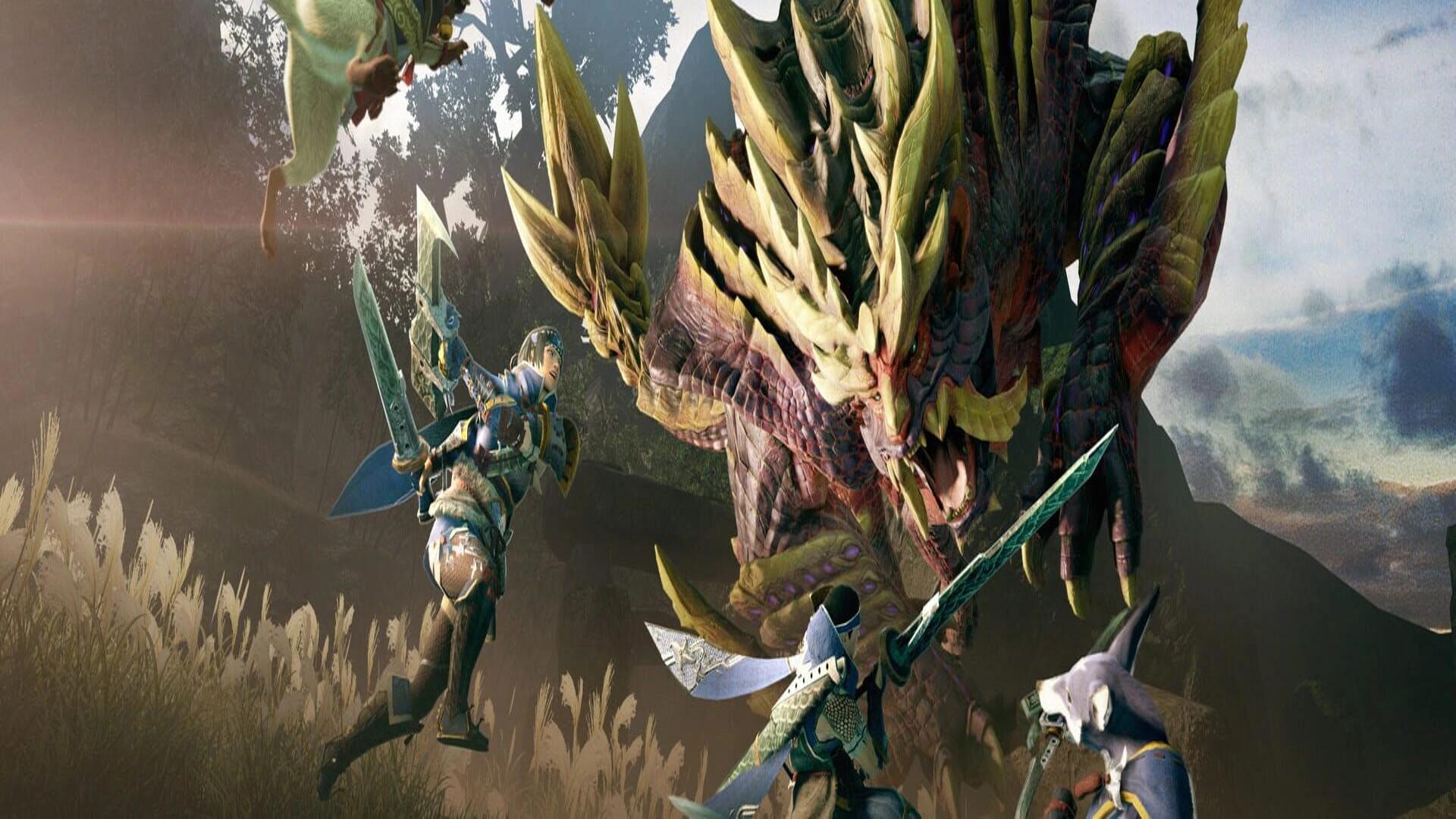
Monster Hunter Rise got displaced by Wilds for the top ten, but it's still one of the fastest, most accessible co-op action RPGs on Xbox. Wirebug movement makes every hunt feel quicker than the older games, and I've cleared full hunts with two friends in under twenty minutes, gear already half-broken by the finish. Returning players who bounced off older Monster Hunter friction should try this one before Wilds if session length matters more than the newest gear system. Lighter and faster, not lesser.
Monster Hunter Rise
March 26, 2021RPGESRB T
About Monster Hunter Rise
Story setup
At a glance
- Released
- March 26, 2021
- Platforms
- Xbox One, Nintendo Switch, PlayStation 5, PlayStation 4, PC, Xbox Series X/S
- Genres
- RPG, Action, Adventure
- Play modes
- Single Player, Multiplayer, Co-op
- Age rating
- ESRB T
Screenshots
Click any screenshot to view it full size.
Multiplayer & game modes
Monster Hunter Rise offers various play modes for different gaming experiences.
Play Modes
Single Player • Multiplayer • Co-op
Age ratings
How rating boards around the world have classified Monster Hunter Rise. Open a board for its content descriptors.
CEROC
- Sexual Content
- Violence
CLASS_IND12
- Violência (Violence)
- Drogas Lícitas (Legal Drugs)
ESRBT
- Alcohol Reference
- Blood
- Violence
GRAC15+
- Violence
- Alcohol, Tobacco, Drug
PEGI12
- Violence
This game contains frequent depictions of realistic looking violence towards fantasy characters. When creatures are struck, blood appears and they let out grunts of pain. In some cases, parts of their bodies, such as tails, can be removed, although there are no gore effects. When a significant amount of damage has been inflicted, the creatures begin to limp. When defeated, they fall to the floor where their body remains. The game also contains frequent depictions of non-realistic looking violence towards human-like and animal-like characters. Characters can be thrown large distances, both into the air and into objects such as rocks and trees. Human characters grunt in pain when they are attacked and some mild blood effects are shown, although there is no sight of injuries. Human characters tend to recover their balance before continuing the battle.
Often listed alongside Monster Hunter Rise
Titles that appear in the same guides on this site. Grouped by where they show up, not by recommendation.
Featured in our articles
This game appears in 12 articles on this site.
Monster Hunter Rise asks a lot of your evenings, and I say that as someone who quit Diablo IV halfway through. This is a game built for a dedicated group, not a one-off drop-in session. The SOS flare system lets you call for help mid-hunt, and lobbies still fill fast years after launch. No shortcuts here. Four hunters, one monster, hunts that run twenty minutes if everyone plays their part. Learning a single weapon type takes hours before you stop feeling like dead weight. That barrier is real, and it's the reason this doesn't rank higher on a list built for pickup-and-play. For a committed weekly group, though, few Switch games reward the investment like this one does.
Monster Hunter Rise is the older, lighter sibling to Wilds higher up this list, and for some LAN groups it is actually the better pick. Hunts run shorter and the game asks less of your hardware, which matters when half your table is on a laptop not built for gaming. Load times are fast, too. Progression leans entirely on weapon mastery and gear crafting rather than stat menus, so a new player can join hunt three without anyone explaining a build first. I would put Wilds ahead of it for spectacle, but Rise wins on pure session efficiency. That efficiency is also its ceiling, the RPG systems here are thinner than anywhere else in this list's top half.
Monster Hunter Rise is the game on this list that asks the most from you before it starts giving back. The first few hours are tutorials inside tutorials, and the weapon variety is wide enough to be genuinely overwhelming. Stick with it, or better, go in with someone who already knows the loop, and it becomes one of the most rewarding co-op experiences on Switch. Four players chasing a Magnamalo across a Shrine Ruins map with everyone running a different weapon type is something you don't forget. Built natively for the Switch hardware, which is more obvious here than with most ports. Runs well, loads quickly, and works in handheld without compromise. Not for everyone. For the right group, nothing else comes close.
With Monster Hunter Wilds sitting at seven, Rise earns its honorable mention by being the friendlier entry point. The hunts are shorter, the systems are approachable faster, and the session rhythm suits groups who want to squeeze a couple of hunts into an evening without a two-hour warm-up. If your co-op partner is new to the series and Wilds feels like too steep an ask, start here. The content depth is lower than Wilds and the world is less visually impressive, but the core loop is intact and the co-op quality is genuinely strong.
Monster Hunter Rise was designed for a handheld first. That lineage shows. Hunts take fifteen to thirty minutes, the quest-select lobby gets you into co-op without friction, and the controller mapping on Deck feels like it was built specifically for this hardware. I came to Rise after World, which I loved but could not finish in one sitting without losing track of where I was. Rise solves that. You pick a hunt, you do the hunt, you return to camp. The drop-in co-op is the best version of that loop, especially when someone in your squad actually knows the monster's patterns and you spend the whole fight trying to keep up.
Monster Hunter Rise does not have old-school native LAN, but its private quest sessions work cleanly for same-room groups and the hunt structure is almost perfectly designed for LAN play. Each hunt runs fifteen to thirty minutes, you can immediately queue the next one, and the weapon variety means four players naturally end up in different roles without any discussion. The barrier is the first few hours: Monster Hunter has a vocabulary you need to learn before the loop clicks. Groups willing to put in that session will get enormous replay value in return. Rise is more accessible than World was at launch, but patient groups will get more out of it long-term.
Monster Hunter Rise is the version of the series that finally clicked for me in terms of session length. Each hunt runs 20 to 40 minutes, which is exactly what you want when you cannot guarantee a three-hour block. My group picked this up after we burned through our Helldivers 2 rotation and wanted something with more structure per run and less randomness in the difficulty curve. The co-op design is built around four distinct weapon roles that reward playing together intelligently rather than just pointing everyone at the same monster. Steam Deck performance is strong, the controls translate well, and the long-term progression gives you a reason to keep coming back week after week.
Monster Hunter Rise is the right entry in the series for a Steam Deck list. Hunt missions take thirty to forty minutes and the controls translated from Nintendo Switch hardware with enough care that playing on Deck feels natural. It carries a Playable label and performs solidly at sensible settings. I kept it out of the main ten because the onboarding asks for patience that not every player will have, and the genre appeal is narrower than most other games ranked above it. For the right player, though, this is hundreds of hours of content in a form factor that actually suits it.
This is the game I think about when someone asks what the Switch can actually do for a serious co-op group. Four hunters, each running a different weapon type, each contributing something specific to a 20-minute hunt that falls apart if one person is not doing their job. I gravitate toward hammer weapons because I have no patience for subtlety, which means I am constantly trying to position near whoever is pinning the monster. The first few hours are slow and the weapon tutorials are more like suggestions than explanations. Push through that. After ten hours of hunts, the coordination required is unlike anything else on the platform.
Monster Hunter Rise is an excellent hunt-based co-op game that narrowly missed the main list because World: Iceborne edges it out as the recommended starting point for new groups. Rise's Wirebug mechanics and faster hunt pace are genuinely great, but Sunbreak (the expansion required for real endgame depth) is an additional cost, and the hub quest system for co-op can confuse newcomers more than World's structure does. Veteran Monster Hunter groups who prefer Rise's mobility-focused combat over World's heavier feel will find equal hours of content here. Runs via PS4 backward compatibility on PS5.
Monster Hunter Rise is all about teaming up to track, fight, and carve enormous creatures in carefully planned hunts. It ranks first because its co-op systems go deep—every weapon plays like a different role, and smart teams coordinate traps, buffs, and positioning to bring monsters down efficiently. I've seen groups of two or three genuinely specialize: one player runs support Hunting Horn buffs while others play aggressive Insect Glaive or Bowgun. Long-term progression and the Sunbreak expansion give groups a huge ladder of goals to climb together, which drives replay for months. The steep learning curve is real, though—new players will need a few solo hours before online hunts click. For committed squads who want intricate teamwork and stable online play, nothing else on Switch comes close.
Game data and imagery provided by IGDB.com