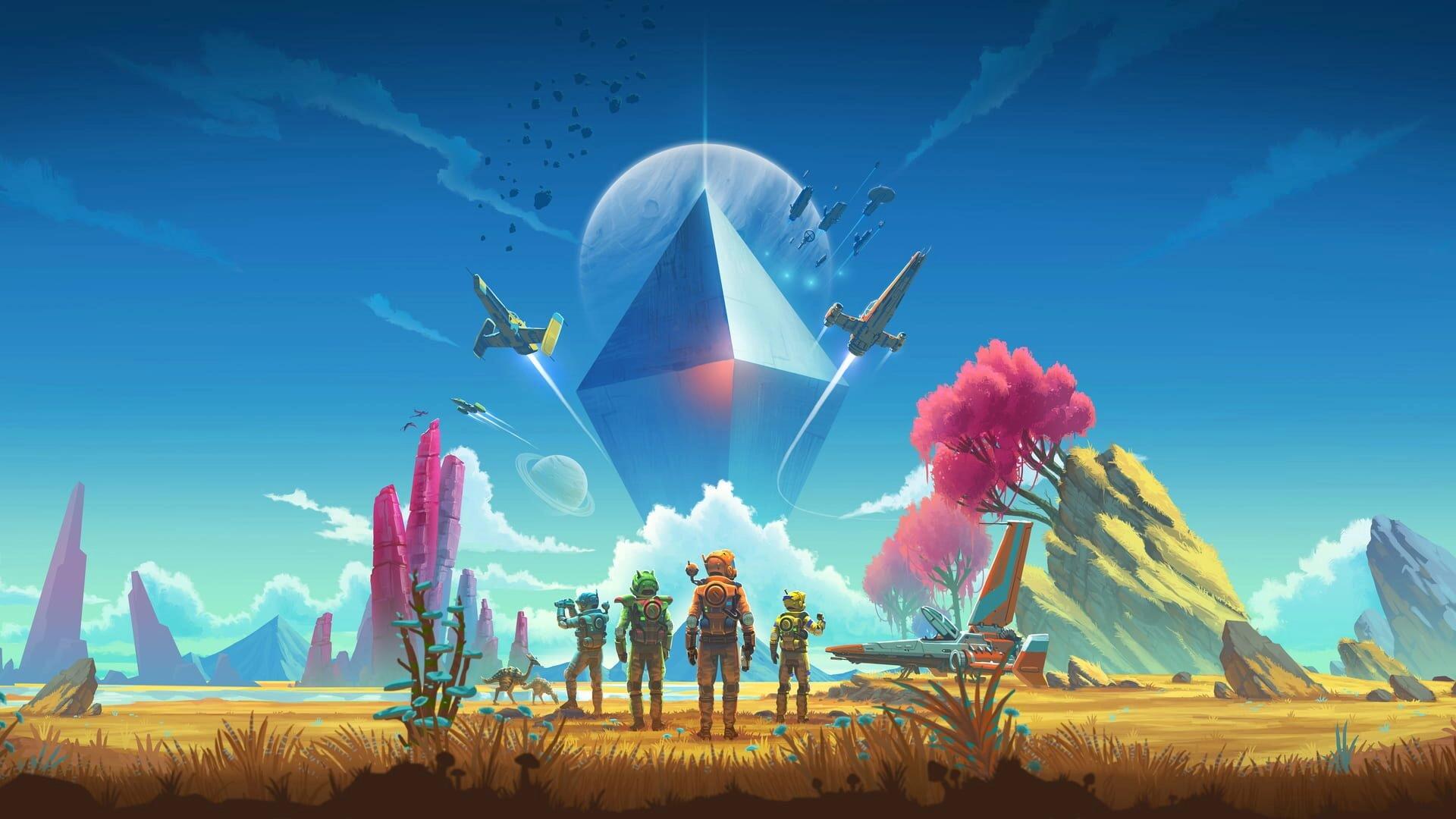
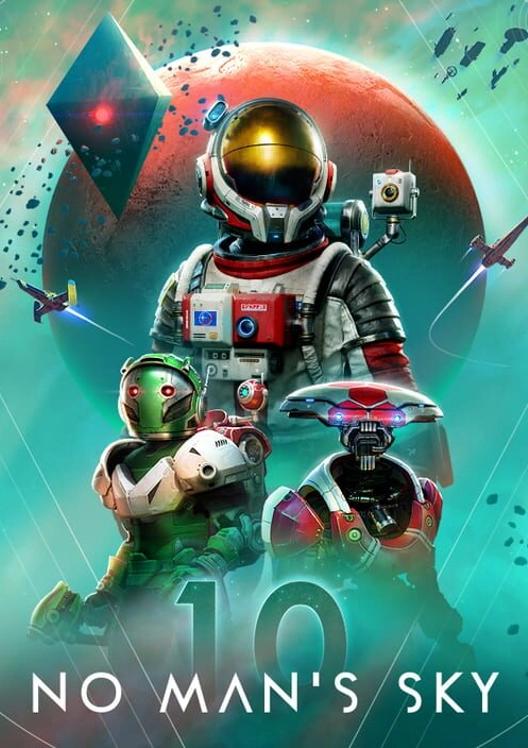

No Man's Sky is a strange fit for a cozy list, and I almost left it off entirely. Relaxed mode helps a lot. Set the difficulty down and two players can spend an evening wandering a planet's surface, finding new creatures without any real threat of dying. The systems are denser than anything else on this list, crafting menus, inventory management, ship upgrades, and that complexity is the main thing keeping it out of the ranked ten. Patient players who like a slower kind of togetherness, rather than a guided cozy loop, will find plenty here.


No Man's Sky
August 9, 2016ShooterESRB T
About No Man's Sky
Story setup
At a glance
- Released
- August 9, 2016
- Platforms
- Xbox Series X/S, Nintendo Switch 2, Xbox One, PC, macOS, PlayStation 4, PlayStation 5
- Genres
- Shooter, Simulation, Adventure, Indie, Arcade, Action
- Play modes
- Single Player, Multiplayer, Co-op, Online Multiplayer
- Age rating
- ESRB T
- Multiplayer
- By platform
Screenshots
Click any screenshot to view it full size.
Multiplayer by platform
How No Man's Sky supports playing with other people, broken down per platform.
| Platform | Local | Online | LAN | Split-screen | Co-op campaign | Drop-in/out |
|---|---|---|---|---|---|---|
| PC | No | Yes, up to 32 players | No | No | Yes | Yes |
- Supported (a number is the player cap)
- Not supported
- Not documented for this platform
Age ratings
How rating boards around the world have classified No Man's Sky. Open a board for its content descriptors.
CEROB
- Violence
CLASS_IND10
- Violência (Violence)
ESRBT
- Animated Blood
- Fantasy Violence
GRAC12+
- Violence
Often listed alongside No Man's Sky
Titles that appear in the same guides on this site. Grouped by where they show up, not by recommendation.
Featured in our articles
This game appears in 20 articles on this site.
No Man's Sky is the closest thing here to the open world I actually love, a place worth moving slowly through, purely for what's over the next ridge. Playing it with friends changes that calculus completely. Landing near a stranger's half-built base on an alien beach and getting roped into finishing their landing pad is a different kind of fun than solo wandering, but it is fun. The galaxy is genuinely enormous, and the base-building and expedition systems give a group actual long-term goals beyond just admiring the view together. Combat is still the weakest part of the package. It's serviceable rather than exciting, and that's fine, because nobody logs into No Man's Sky to fight, they log in to build something and show someone else.
No Man's Sky asks you to manage hazard protection, harvest resources, and watch your life support, except the scale here is a galaxy instead of one ocean. I picked it back up years after launch, once the survival pressure had softened into something closer to a very pretty building simulator, and that's fine by me. It's the kind of open world I gravitate toward: worth moving through slowly, with a horizon that never stops being interesting. The catch: stakes fade fast. Suit upgrades arrive fast, and by the third planet the harshest threats are basically gone. That's why it ranks below games that stay uncomfortable the whole way through. Still one of the most polished picks on PS5, and an easy recommendation for anyone who wants survival without the punishment.
No Man's Sky is less about coordinated teamwork and more about showing up in the same universe as your friends and doing your own thing nearby, which suits my group fine on nights when nobody wants to commit to a real mission. I like open worlds that reward curiosity over ones that just deliver content on a checklist, and this is one of the few sandboxes big enough that four people can each go build something different and still bump into each other occasionally. Crossplay spans Xbox, PlayStation, Switch, and PC. The co-op here is looser than anything else on this list. If your group wants tight objectives and constant communication, look higher up. If you want a shared space to potter around in, this earns its spot.
No Man's Sky and Starfield get compared constantly, and after playing both back to back I get why. This one commits harder to the exploration fantasy Starfield only half delivers. Every planet you land on is procedurally generated, but the base building and crafting give you a reason to actually stay on one instead of hopping to the next. It's less handcrafted than the story-driven games higher on this list, quest content is thin and the writing won't stick with you. I still find myself loading it up on quiet evenings just to see what a random planet looks like. Not for people who want a story to chase. For pure planetary wandering, though, it's hard to beat.
No Man's Sky earns its spot through sheer stubbornness, both the studio's and mine. I bounced off it in 2016 like most people did, and only went back years later out of curiosity about how many promises had actually been kept. Turns out, most of them. Every planet is procedurally generated, so the exploration high is real but any single discovery runs shallower than a hand-crafted world like Horizon's. I still land on a purple-skied planet with no mission attached just to see what's there, and there's something calming about that kind of aimless wandering after a long day. Hello Games keeps shipping free updates years on, which is more than most games on this list can claim.
No Man's Sky landed on Switch years after its rocky launch reputation had been thoroughly reversed by years of free updates, which is actually the ideal time to play it. The fantasy is planet-hopping. You land on a frozen world, scan the flora, name a creature, leave your mark, and lift off toward a space station you spotted on the way down. The Switch version is the weakest technically on this list, with noticeable visual cuts and longer load times between planets. Solo, it leans toward meditative exploration rather than active challenge. For a certain kind of player, that is exactly what they want from a portable session. Know which kind you are before buying.
No Man's Sky is the most ambitious open world on this list by a significant margin. The problem for a LAN party context is that it leans on Hello Games' servers for multiplayer infrastructure in a way the dedicated-server sandboxes do not. We ran a session where two people explored the same planet in parallel and barely crossed paths for two hours. That is more parallel play than co-op. For an exploration-first group who just wants to share a universe and check in on each other's bases, that is fine. For a group that wants active shared objectives, you will want something higher on the main list.
No Man's Sky occupies a specific kind of co-op space: parallel play in a shared world rather than tight coordination toward a single objective. You are both building, both exploring, sometimes meeting up and sometimes not. I had a group settle a frozen moon together over several weeks, each of us working on something different between sessions, and it held together because the world was persistent and the goals were self-directed. The PvE missions and expeditions do bring the group together when you want structure. Just know going in that this is more about inhabiting a shared space than completing missions as a unit.
No Man's Sky is the game that keeps proving people wrong. Launched in a state that deserved the criticism it received, then received years of free updates until it became something genuinely worth recommending. I dropped into a friend's base on a frozen moon one evening expecting to stay for an hour. We were still building two hours later. The co-op here is parallel rather than tightly coordinated, which means it suits groups that want to share a world rather than complete objectives together. Cross-platform works across the major ecosystems, though the friend-invite flow is slightly less polished than Fortnite or Rocket League. Still, for groups that want a long, slow, collaborative experience with no matchmaking pressure, nothing else on this list scratches the same itch.
Enshrouded leans RPG more than the other games on this list, and that is both its appeal and the honest reason it sits at five rather than higher. The survival and crafting systems are real, but what pulls you forward between sessions is more likely the gear upgrade you are chasing or the next story dungeon than the pressure of keeping your character alive. I find that a compelling trade-off rather than a flaw. The building tools are some of the best in the genre, the world is genuinely worth exploring, and a group with a persistent shared base can sink serious hours into this without the loop wearing thin. Just go in knowing this is survival-adjacent territory, not the brutal end of the spectrum.
No Man's Sky is not a traditional RPG, and I will not pretend otherwise. But after years of free updates it has accumulated enough progression depth, technology upgrades, ship and multitool builds, and mission structure that dismissing it from this list felt like underselling what it actually offers co-op groups today. My experience with it is exactly what the game does best: you and a friend end up on a frozen moon with a half-built base, each quietly pursuing a different project, and somehow four hours pass. The progression is classless and sprawling rather than structured. For groups wanting something long-term and low-pressure to return to between more demanding sessions, it earns its place.
I already know how No Man's Sky plays with a group because I wrote about it in a different context, and the pattern holds here too: it starts as active survival and gradually becomes parallel play in the best way. Early on, hazardous planets, resource management, and shelter genuinely matter. Later, you and your friends are quietly building separate projects in the same star system and occasionally regrouping to show each other what you made. The PS5 version is polished in ways the original launch absolutely was not. If your group wants a survival sandbox with enormous visual variety and no pressure to race toward a finish line, this is the pick.
My honest expectation when I loaded No Man's Sky on Switch was that it would be a compromise version of something better on PS5. It is a compromise on paper, yes. In practice, landing on a planet with a friend, scanning alien fauna neither of you has seen before, and realising neither of you knows what direction the base is in is still completely absorbing. The co-op is less tightly structured than Minecraft or Terraria, which is why it sits at three rather than one. But for pure exploration scale, nothing else on this list comes close. Each session feels self-contained in a way that works for limited evening windows.
I started a No Man's Sky session with one friend intending to spend an hour looking around. Four hours later we had a shared base on an irradiated planet, a fleet of freighters between us, and a standing argument about whether to colonise the next system or stay and finish the base. That kind of session does not happen in a game that is just going through the motions. The world here is genuinely infinite, the co-op builds naturally into everything you do, and Hello Games has kept expanding it for years without charging for updates. The PS5 version is polished enough that it no longer feels like an apology for the launch. It earned the top spot.
No Man's Sky is the open world you return to rather than commit to. You land on a planet, mine for a while, upgrade your ship, warp to the next system, and an hour disappears. My group tried it as a shared-world session once and spent the whole evening in different corners of the same planet doing completely different things. On Deck the technical performance is the one reservation, it can run warm and the settings need attention, but the solo exploration loop is strong enough to justify the honourable mention. If you want endless planetary variety without a quest list telling you what to prioritize, nothing else here offers it.
No Man's Sky has become something strange and good over the years of free updates. Cross-platform co-op works for exploration and base building, and the game rewards groups that like to play at their own pace without a fixed objective. I spent a few weeks on a shared world with friends where we barely spoke in voice chat and just built things near each other. That is a legitimate type of multiplayer and No Man's Sky does it well. It does not crack the main list because the crossplay is less central to the experience than it is on every game above it, and the parallel-play style is not what most people mean when they say they want a crossplay game.
No Man's Sky has the simplest crossplay setup on this list — no external accounts, no linking, just session codes and in-game invites for PS5, Xbox, and PC players to explore together. Hello Games keeps updating it, which means the co-op experience in 2026 is considerably better than what launched years ago. Expeditions are the structured co-op highlight: time-limited community events with shared objectives and unique rewards. The session-joining occasionally hiccups, and there's no cross-save. Switch players are also out — the Switch version doesn't support multiplayer. But for a relaxed exploration and base-building group across PS5, Xbox, and PC who just want to start playing without any setup headache, this is the smoothest entry point.
No Man's Sky is the loosest co-op on this list — each player maintains their own inventory and base, and there's no tight coordination loop forcing you to work together. What it offers instead is something harder to find: an enormous shared sandbox where you set your own goals. Want to build a base together? Run seasonal expeditions side by side? Explore planets and radio each other when you find something strange? All of that works, and it works at your own pace. Highly customizable difficulty, cross-play support, and hundreds of hours of content make it the best pick for duos who want a long-term low-pressure world to return to. Just don't expect tight co-op mechanics — that's not what this is.
No Man's Sky has had one of the most remarkable second acts in gaming. The version that exists now bears almost no resemblance to the one that launched to disappointment. Base building, multiplayer, narrative missions, underwater exploration. It has grown into a genuinely broad survival and exploration game. The reason it sits here is the hardware floor. On Intel UHD 620-class machines, it is a borderline experience. I tested it and the frame drops in dense planet environments are real. On Iris Xe or newer budget hardware it performs acceptably. If your machine is on the stronger end of low-end, it earns a place. On truly weak hardware, start with something higher on this list first.
Game data and imagery provided by IGDB.com